

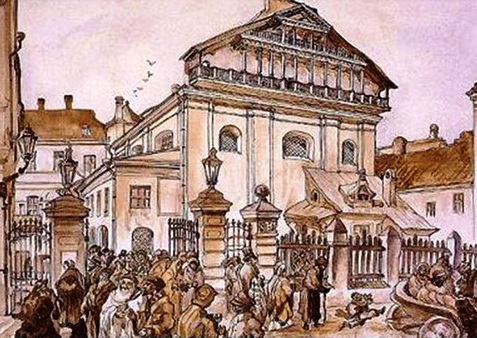
Between Yerushalayim DeLita and Jerusalem – The Memorial Inscription from the Bimah of the Great Synagogue of Vilna
Summary
During excavations of the bimah (the platform for reading the Torah) of the 17th-century Great Synagogue of Vilna (Vilnius, Lithuania), an important memorial inscription was exposed. This page describes the new finds associated with the baroque-rococo architecture of the bimah and focuses on the inscription and its meaning. The Hebrew inscription, engraved on a large stone slab, is a complex rabbinic text filled with biblical allusions, symbolism, gematria and abbreviations. The text describes the donation of a Torah reading table in 1796 in honour of R. Ḥayim ben Ḥayim and of Sarah by their sons, R. Eliezer and Shmuel. The inscription notes the aliyah (emigration) of Ḥayim and Sarah to Eretz Israel, the Land of Israel. The interpretation of the inscription shows the use of multiple messianic motifs. Historical analysis identifies the involvement of the Vilna community with the support of the Yishuv (the Jewish community in Ottoman Palestine) and the aliyah of senior scholars and community leaders at the end of the 18th and early 19th centuries. Amongst these figures were Ḥayim ben Ḥayim and Sarah, with Ḥayim ben Ḥayim going on to represent the Vilna community in the Land of Israel as its emissary, distributing charitable donations to the scholarly Ashkenazi community resident in Tiberias, Safed and later Jerusalem.
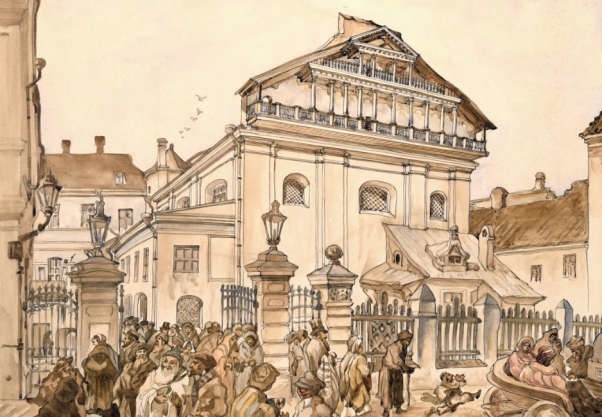
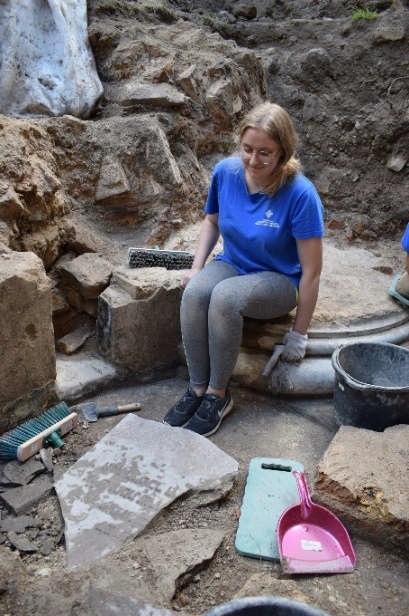
Since 2016 the Vilna Synagogue and Shulhoyf Research Project has been excavating the site of the Great Synagogue of Vilna, the most important edifice of Lithuanian Jewry until its ransacking by the Germans in 1941 and its demolition under Soviet rule in 1956–1957. During the excavations of 2018–2019 sections of the bimah were uncovered, including an important memorial inscription that had once been set at the foot of the bimah.
The Bimah
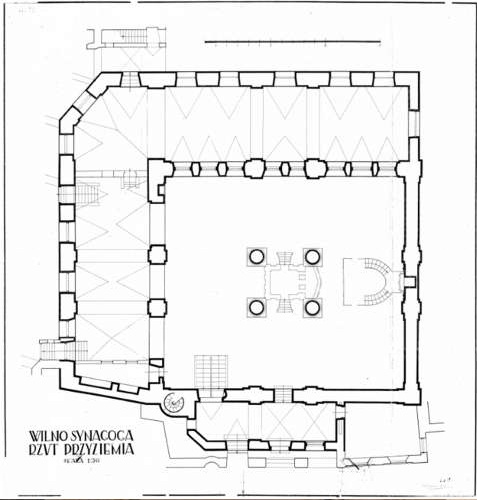
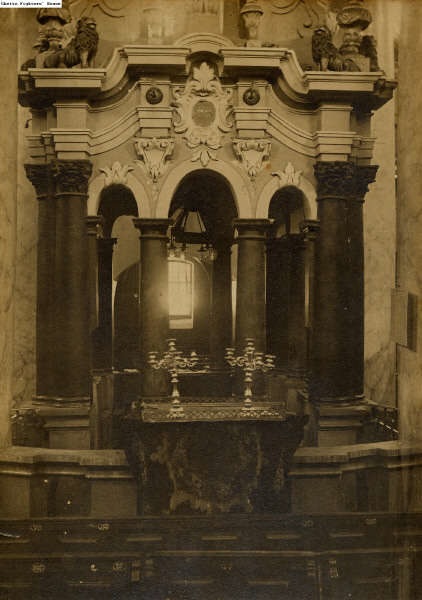
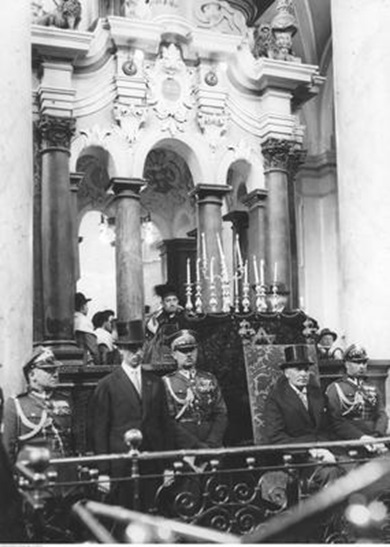
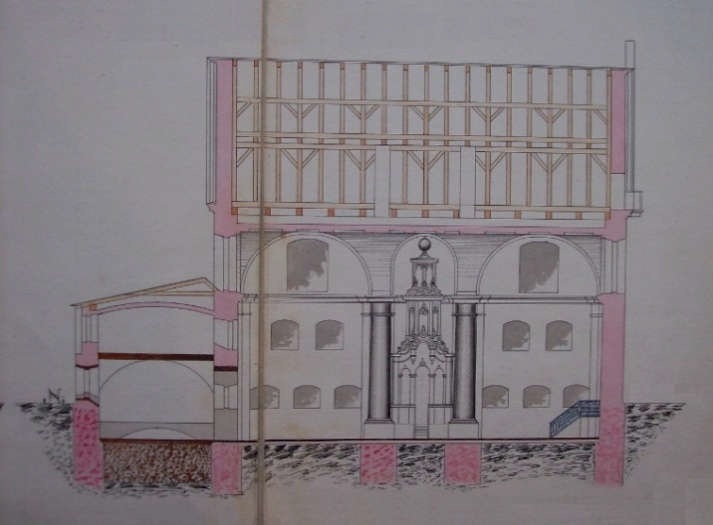
The bimah stood between the four large central columns of the prayer hall. Nothing is known of the original bimah, which was dismantled when a new one was donated in the mid-18th century by the benefactor Yehuda ben Eliezer, known by his acronym as the Yesod (Yehuda Safra ve’Deyana). The three-tiered bimah in Rococo ornamentation, usually attributed to the architect Johann Christoph Glaubitz, was 11.6 m high, almost reaching the synagogue ceiling. The three tiers rose like a wedding cake, each lower and narrower than the one below, all set on a 0.9-m-high base measuring 3.8 × 3.2 m.
The bottom tier, some 3.9 m high, was entered from the sides by two staircases with decorative wrought-iron banisters. It was surrounded by a built balustrade with twelve columns – four red corner columns with Corinthian capitals, each pair divided by two green Tuscan columns. Broken cornices, ornamented with rocailles and floral designs, finished this tier, guarded by four crouching lions at the corners, each separated by two urns. A curved loge on the south-eastern side faced the Torah ark; at the centre of its balustrade was a widened section on which the Torah reading table stood. The upper tiers were purely decorative: an octagonal second tier, 3.5 m high, with arched openings and a curved cornice, topped by a narrower 3.3-m-high tier capped by a sloped roof and ball.
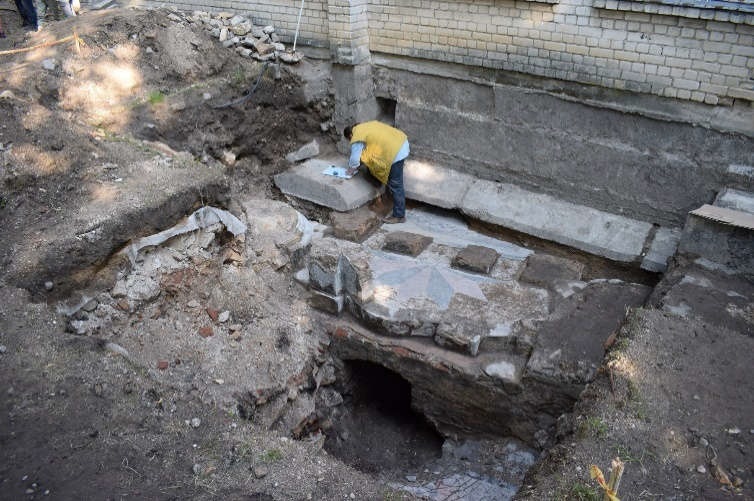
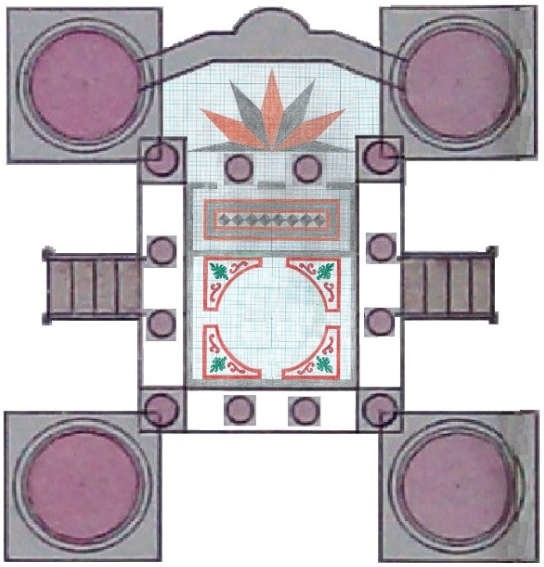
Sections of the bimah were exposed in the excavations of 2011, 2018 and 2019. The floor of the bimah is of terrazzo alla veneziana, probably laid around the turn of the 20th century during the renovation supervised by the engineer Leonid Viner, when a large part of the main hall was paved in the same material. It is divided into three panels on a greyish-brown background. In the front loge are seven radiating red and black lozenges, the central red lozenge pointing towards the Torah ark; the front part of the area within the twelve columns has red and black rectangles with black diamonds, and in the four corners are light green leaves flanked by red tendrils.
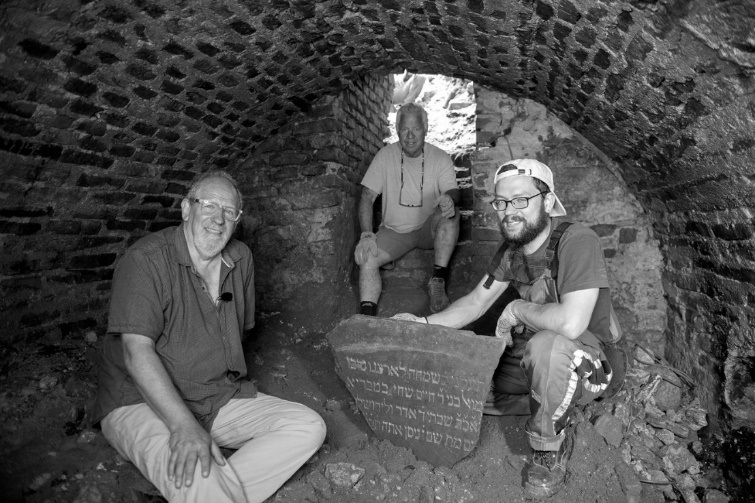
A further surprise was an unknown vaulted brick cellar below the bimah. An arched opening at the front led down five steps into a space occupying the full area beneath the bimah, with two pairs of metal pegs on either side of the entrance. The cellar contained a few hundred coins, most of the 17th–18th centuries, and other finds. It may belong to the base of the original Baroque bimah, reused for the new structure. The cellar is not mentioned in any description of the bimah – though it may lie behind the legend of a secret tunnel leading from the Great Synagogue to Troki (Trakai), some 20 km away.
The Inscription
On the floor of the loge of the bimah and inside the cellar lay twenty pieces of an inscribed red sandstone slab measuring 1.4 × 1.1 m, shattered by a single blow at its centre. The slab was carefully finished on three edges, the bottom edge left rough like that of a maẓevah (tombstone), whose unfinished foot is planted in the ground. On its upper third are four lines of deeply incised Hebrew text, some 3.5 cm high, in a careful Ashkenazi script that developed in printed books in Amsterdam in the 17th century and was later adopted in Lithuania. Remains of gilding survived in the letters, the gold set over a white chalky base. Marks of a bowed arch over the top of the slab are probably the remains of a frame.
The only written reference to the inscription, by Steinschneider (1900), states that the stone was part of a Torah reading table. Because of its large size, its shape and its unfinished bottom edge, we believe that the slab covered the entrance to the cellar, fixed by the four metal pegs with its rough edge sunk into the floor. The inscription thus marks the donation of the Torah reading table that stood above it, on the widened balustrade of the loge at the front of the bimah. It is not visible in any known photograph, probably because it was covered by the cloth draped over the reading table.
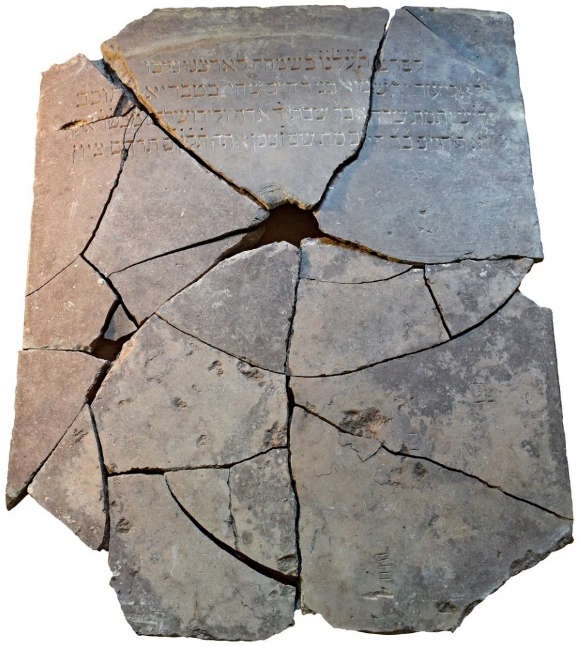
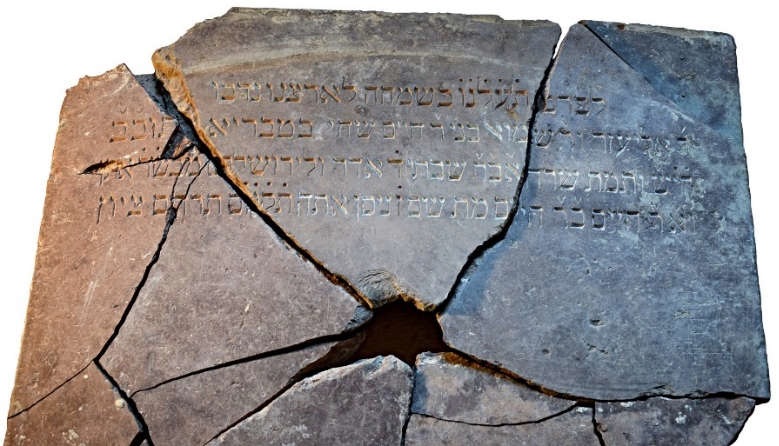
The inscription is a complex rabbinic text filled with biblical allusions, symbolism, gematria and abbreviations. It reads:
(1) לפרט תׄעׄלׄנׄוׄ בשמחה לארצנו נדבו
(2) ר׳ (ר״ת רב) אליעזר ור׳ שמואל בני ר׳ חיים שחי בטבריא תובב״א (ר״ת – תבנה ותכונן במהרה בימינו)
(3) חׄיׄש׳ (ר״ת – חיי שרה) ותמת שרה אב״ר (ר״ת – אמינו בת רב) שבתי דׄ אדר ולירושלים מׄבׄשׄרׄ אתן
(4) וא״ר (ר״ת – ואבינו רב) חיים ב״ר חיים מת שם זׄ ניסן אתה תׄקׄוׄםׄ תרחם ציון
(1) Bring us up ([5]556, i.e. 1796/97 CE) with joy to our land. Donated by
(2) R. Eliezer and R. Shmuel, sons of R. Ḥayim who lived in Tiberias, may it be rebuilt and re-established in our days
(3) for the life of Sarah (= 18 years), and Sarah died, our mother, daughter of R. Shabbtai, on the 4th of Adar, and I gave to Jerusalem a messenger of good tidings ([5]542, i.e. 18 February 1782)
(4) and our father R. Ḥayim son of R. Ḥayim died there on the 7th of Nissan, arise ([5]546, i.e. 20 March 1787) and have compassion on Zion
A dot above a letter shows that it should also be read as a number; other marks show that a letter is part of an abbreviation. Read simply, the text records the donation in 1796 of the Torah reading table by R. Eliezer and Shmuel, sons of R. Ḥayim, who made aliyah to Tiberias and lived there for 18 years; in memory of their mother Sarah, daughter of R. Shabtai, who died on 4 Adar 5542 (18 February 1782); and of their father, R. Ḥayim son of R. Ḥayim, who died on 7 Nissan 5546 (20 March 1787). Beyond that, the symbolism and double meanings need interpretation.
The opening phrase, תַּעֲלֵנוּ בְשִׂמְחָה לְאַרְצֵנוּ (“Bring us up with joy to our land”), comes from the Mussaf Amidah prayer recited on the Sabbath. Here it is the return (aliyah) to the Land of Israel that matters, through R. Ḥayim’s aliyah to Tiberias and its possible messianic association; the word תעלנו also gives, in gematria, the year of the dedication, [5]556 (1796). The theme continues in the second line with the abbreviation תובב״א (“may it be rebuilt and re-established in our days”) after the name of Tiberias – an abbreviation used for the four holy cities of the Land of Israel, Jerusalem, Hebron, Safed and Tiberias, referring to their future messianic rebuilding.
The third line opens with an abbreviation for the Torah portion Ḥayei Sarah (“Life of Sarah”, Genesis 23:1–25:18), which doubles as the name of the donors’ mother. Its first two letters have the numerical value 18, and the third probably stands for “years” – probably the period that R. Ḥayim lived in Tiberias before his death in 1787, so that he arrived there in 1769. The line continues with “and Sarah died” (Genesis 23:2), referring both to the biblical Sarah and to the donors’ mother, and then with another messianic reference, “and to Jerusalem a messenger of good tidings” (Isaiah 41:27), in which the word מבשר gives the year of Sarah’s death, [5]542 (1782). The last line quotes Psalms 102:14, “arise and have compassion on Zion”, recited during Sliḥot before the Day of Atonement but also referring to the return to Zion; the word תקום gives the year of Ḥayim’s death, [5]546 (1787).
All four men are given the honorific ר׳ (R.), which can mean “Reb” (“Mr.”), marking them as affluent community leaders, or “Rav”, showing that some or all of them were rabbis. Within hours of the discovery, a reference to the inscription was found in Sefer Ir Vilna (Book of the City of Vilna), published in 1900 by Hillel Noah Maggid Steinschneider, which notes that it was cut on a large slab of red “marble” donated by the brothers Eliezer and Shmuel for the Torah reading table. With this and Shmuel Finn’s Kiryah Ne’emana (1860), the history of the stone and of the people it names could be pieced together.
Synagogue Inscriptions
Memorial and dedicatory inscriptions have been a feature of synagogues from the Second Temple period and late Antiquity to modern times. They usually ask that the donor be remembered for his good deed, and sometimes give the sum donated, the date of the building and an appeal for future redemption. As in Vilna, such texts were often composed in the spirit of piyyut, with symbolic allusions, liturgical hints, biblical phrases and gematria riddles. A dedicatory inscription of 1034 from the synagogue at Worms – also cut in red sandstone – asks that the donor Jacob ben David be remembered every Sabbath “along with the sleeping men of Hebron”, the Patriarchs buried in the Tomb of the Patriarchs: as in Vilna, the synagogue service is linked with a messianic reference to one of the holy cities of the Land of Israel. A tombstone from Brody in Galicia, decorated with a ship, commemorates Malka bat Yitzhak Babad (d. 1834), a relative of Shmuel’s father-in-law, who made aliyah with her father, probably with the same group of emigrants from Vilna and Brody, before returning home.
Ḥayim, Sarah, Eliezer and Shmuel and the Aliyah from Vilna
Whether the aliyah of the followers and pupils of the Gaon of Vilna at the end of the 18th and early 19th centuries is seen as messianic proto-Zionism or as traditional religious migration to create a scholarly Torah community in the Holy Land, it led to the founding of Ashkenazi communities in Tiberias, Safed and Jerusalem that survive to this day. Whatever the motivation, messianic ideology is clearly present in the inscription itself, which quotes three liturgical and biblical texts on redemption: the Mussaf Amidah, Isaiah 41:27 and Psalms 102:14.
After the collapse of the Ashkenazi community of Jerusalem led by Rabbi Yehuda Ḥassid early in the 18th century, the Jews of Lithuania became deeply committed to the Yishuv, through aliyah or financial support. In 1770 leading rabbis and community leaders met in Vilna to discuss the support of the Ashkenazi community in the Land of Israel and even sent immigrants to strengthen it. Foremost in this movement was Azriel of Shklov, a leader of a small group of families who emigrated around 1772. Among them was Ḥayim ben Ḥayim Shebtels, a wealthy benefactor and leader of the Vilna kahal, who seems to have arrived as a harbinger in 1769, a little before the others. Heavy debts owed by the Ashkenazi community to Arab creditors prevented settlement in Jerusalem, so the group settled in Safed, where they established a bet midrash in the name of the Gaon of Vilna, and in Tiberias.
In Tiberias Ḥayim represented the “Nobles of Vilna” (רוזני וילנה), the community leaders who financed the Yishuv, headed by his own sons Shmuel and Eliezer, who had remained in Vilna as the Land of Israel treasurers. In a letter to Berkhi Berakh Segal of Brody, the brothers wrote that “our community sends money to the Holy Land each and every year; it reaches its destination at no expense whatsoever, to the hands of the preeminent rabbi, the famous noble, our mentor Ḥayim Shepshiller”. As a result, donations from several communities passed through Shmuel and Eliezer to their father, who divided them between the Ḥassidic and the Perushim (Mitnagdim) immigrants.
Ḥayim’s surname, spelled Shebtels, Shepshils or Shepshiller, came from his father-in-law, Shabtai ben Elḥanan Ḥefez, father of Sarah, a descendant of Rabbi Moshe Rivkesh, author of Be’er ha-golah, and related to the Gaon of Vilna; Shabtai was one of the signatories of the appointment of Rabbi Shmuel bar Avigdor as Chief Rabbi of Vilna in 1750. Ḥayim was joined in Tiberias by Sarah, by Shabtai and by his brother-in-law Elḥanan ben Shabtai Ḥefez, both fierce opponents of Hassidism. Shmuel married Rechil, daughter of Ḥayim Segal Landau, head of the Brody kloyz and the Land of Israel treasurer of his community, binding Vilna and Brody together through kinship and their shared involvement in the affairs of the Land of Israel.
This small migration failed to establish itself fully. The major success came in 1808, when Azriel of Shklov’s grandson, Rabbi Israel of Shklov, led the disciples of the Gaon of Vilna who re-established the Ashkenazi community in Jerusalem and later rebuilt the Ḥurva synagogue as its Great Synagogue. In Vilna, Shmuel became a leader of the kahal in 1802–1805, while Eliezer was an opponent of Chief Rabbi Shmuel ben Avigdor. Eliezer (d. 19 March 1805) and Shmuel (d. 1817/18) were buried in the Old Jewish Cemetery of Vilna (Šnipiškės) near the tomb of the Gaon, until its destruction by the Soviets. Eliezer’s epitaph recalls his father, “who went before God to the lands of the living, to the Holy Land of Israel”.
Postscript – From Vilna to Jerusalem
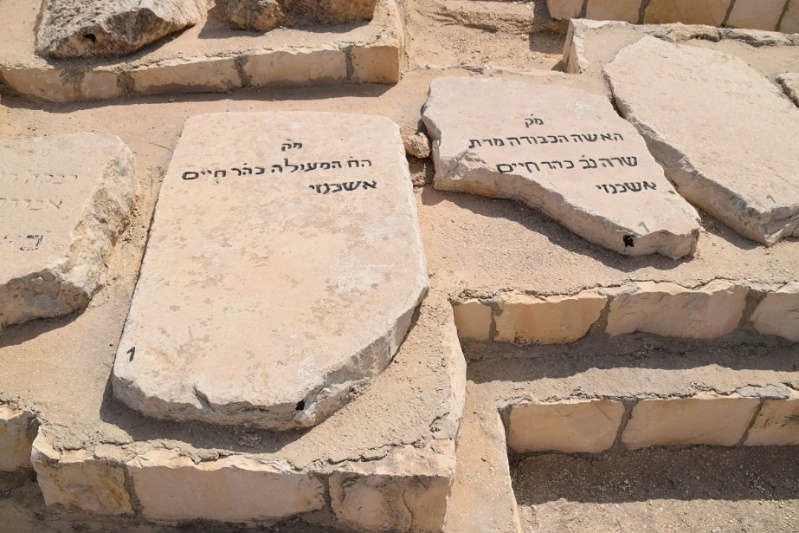
Shmuel and Eliezer can be traced to the cemetery of Vilna – but what of Ḥayim and Sarah? A search of the cemetery of Tiberias was unsuccessful. However, two tombstones side by side in the Sephardi cemetery on the Mount of Olives in Jerusalem may well be theirs. They bear no dates, but lie in a part of the cemetery in use at the right period and are marked “Ashkenazi”: until a separate Ashkenazi cemetery was established in 1855, Ashkenazi Jews were buried in the Sephardi cemetery with their community added to the marker. The epitaphs read: “The place of burial – The sage, the honourable Rabbi Ḥayim Ashkenazi” and “The place of burial – The honourable wife, Mrs. Sarah, the household oasis for the honourable Rabbi Ḥayim Ashkenazi”.
While these tombstones cannot be conclusively identified as those of the Ḥayim and Sarah of the Vilna inscription, their period and simple epitaphs make them worthy candidates – a fitting end in Jerusalem to the journey sparked by the discovery of the inscription in Vilna, Yerushalayim deLita, the Jerusalem of Lithuania.
For more on the synagogue and its bimah, see The Synagogue.
Publication
Jon Seligman. 2020. Between Yerushalayim DeLita and Jerusalem – The Memorial Inscription from the Bimah of the Great Synagogue of Vilna. Arts 9(2): 46. DOI: https://doi.org/10.3390/arts9020046 (open access, with full references).