

Publications
Papers, reports and articles on the Great Synagogue and Shulhoyf of Vilna and the results of the research and excavation project. Click a cover or a title to read the paper (PDF).

Jon Seligman. 2025. Journal of Heritage Management: 1–12. doi:10.1177/24559296251371419
Abstract: The issue of authenticity, continuity and the reconstruction of lost monuments has been the subject of vigorous debate in the philosophy and methodology of heritage conservation since its inception and especially after the Second World War and the collapse of the Soviet bloc. This article discusses the intertwined history of the Great Synagogue of Vilna (Vilnius) in Lithuania and the Ḥurva Synagogue of Jerusalem. Both synagogues, which had been the main ‘cathedral’ shrines for the Jewish communities of Vilna and Jerusalem, were destroyed during the conflict, leaving ruins in their place. After many years of loss and given their importance, an opportunity arose to memorialize or reconstruct these monuments. Special attention is given to the significance of these two synagogues as places of identity and to the way in which changing dynamics in the ethics of heritage management concerning the reconstruction of lost built cultural heritage have affected outcomes at these two sites.
The Bathhouse and Miqweh of the Great Synagogue of Vilna, Lithuania
בית המרחץ והמקווה של בית הכנסת הגדול של וילנה, ליטא
Jon Seligman. 2025. Eretz-Israel 36 (Ronny Reich Volume): 204–217 (Hebrew), English abstract p. 138*. Jerusalem: Israel Exploration Society.
Abstract: The paper discusses the history and development of the miqweh adjacent to the Great Synagogue of Vilna (Vilnius, Lithuania). After introducing the archaeology of the miqweh in Europe, note is made of the changes in halakha occurring in the 19th century that resulted in major changes to the architecture of the miqweh, first in Germany and later in Eastern Europe. Remains of the bathhouse and miqwa’ot building in the shulhoyf (synagogue courtyard) behind the Great Synagogue have been uncovered in the excavation of the site, including two miqweh basins that belong to the latest phase of restoration of the bathhouse in the early 20th century. These remains clearly display that in this latest iteration, the Vilna community was following the changes to halakha relating to purity current in Europe at the time.
New Discoveries and Notes on Two Lost Vilna Synagogues – Zavl’s Kloyz and Zarech’e Kloyz
Jon Seligman. 2023. In Philip Reeder (ed.), Richard Freund’s Legacy of Ideas, Research and Teaching about the Holocaust. Newcastle upon Tyne: Cambridge Scholars Publishing: 35–56.
From the introduction: During the seasons of excavation and research of the Vilna Synagogue and Shulhoyf Research Project, we were exposed to many aspects of the destroyed Jewish past of Vilna, Yerushaláyim d’Lita. While working on the remains of the Great Synagogue we would view from the window of our hotel on Gėlių gatvė, the standing shell of a synagogue, one of 160 pre-war synagogues in the city, and one of the extremely few that survived the Holocaust and the destructive years of Soviet rule. As we became acquainted with Vilnius and the many local residents and scholars who showed genuine interest in our research, we had the opportunity to be shown facets of the city that few see, or to be asked to cast an eye on aspects of lost Jewish life that reappear from time to time during archaeological excavations or building renovations. This paper presents two such experiences, the first involving the discovery and divination of a stamp-seal from the synagogue we saw from the hotel window, known as ‘Zavl’s Kloyz’ and the second, wall paintings from the walls of the former Zarech’e Kloyz in the neighborhood of Užupis, prior to the Shoah a thriving mostly Jewish suburb of Zarech’e, and now the gentrified center of bohemian life of modern Vilnius.
The Bathhouse and Miqva’ot (Ritual Baths) of the Great Synagogue of Vilna, Lithuania
Jon Seligman. 2023. In Philip Reeder (ed.), Richard Freund’s Legacy of Ideas, Research and Teaching about the Holocaust. Newcastle upon Tyne: Cambridge Scholars Publishing: 84–104.
From the prologue: During discussions on the publication of the excavation of the Great Synagogue of Vilna, Richard Freund voiced a deep interest in the subject of ritual purity, as expressed through the excavation of the bathhouse and miqve building exposed during our work. In the final planned publication, Richard had undertaken to conduct a comparative analysis of such structures in eastern Europe, with the bathhouse and miqve building from Vilna providing his primary example. Unfortunately, with Richard’s untimely passing, this was not to be, and I hope this short chapter introduces future discussion on this topic.
The lost “Jewish cathedral” of Vilnius – the excavations of the Great Synagogue of Vilna (2016–2021)
Jon Seligman. 2023. In Paul Salmona, Philippe Blanchard and Amélie Sagasser (eds), Archéologie du judaïsme en Europe. Paris: CNRS Éditions: 121–138. In French.
From the introduction: Une équipe de chercheurs israéliens, lituaniens et nord-américains mène depuis plusieurs années des recherches archéologiques sur le site de la grande synagogue et du shulhoyf (cour de la synagogue) de Vilna (aujourd’hui Vilnius, en Lituanie). La grande synagogue était au cœur de la communauté de Vilna et représentait sans doute – jusqu’à ce qu’elle soit pillée par les nazis et les collaborateurs lituaniens à la fin du mois d’octobre 1941 au cours de la liquidation du petit ghetto, puis détruite en 1956-1957 sous l’occupation soviétique – l’édifice le plus important de la communauté juive lituanienne. À l’emplacement de la grande synagogue a été construite une école d’un modernisme médiocre, qui conserve, dans ses fondations, la partie basse de certains murs de l’ancien édifice bâti, en partie, en dessous du niveau de la rue. Les fouilles ont visé principalement à mettre au jour des éléments de la synagogue, tout particulièrement la bimah et l’arche sainte, ainsi que le bâtiment associant le miqveh et les bains publics.
Preserving Holocaust History: Geophysical Investigations at the Ponary (Paneriai) Extermination Site
Alastair F. McClymont, Paul D. Bauman, Richard A. Freund, Jon Seligman, Harry M. Jol, Philip Reeder, Ken Bensimon and Rokas Vengalis. 2022. Geophysics 87(1): WA15–WA25. doi:10.1190/geo2021-0065.1
Abstract: Holocaust mass grave sites in eastern Europe can be difficult to investigate due to a paucity of historical documentation relating to the events and because the use of traditional invasive archaeology methods raises concerns around the disturbance of the remains of Jewish people. When combined with other lines of evidence, including historic photos and eyewitness testimony, noninvasive geophysical methods help to effectively identify and demarcate buried features at Holocaust sites, limiting unnecessary excavations. Between 1941 and 1944, as many as 100,000 people were murdered at the Ponary (Paneriai) extermination site in Lithuania, but many critical details of the site layout during this period are still to be resolved, including the location of some of the mass graves and confirmation of an escape tunnel that was used by slave laborers to escape captivity and certain death at the site. At Ponary, a combination of electrical resistivity tomography (ERT) profiling, limited ground-penetrating radar data, and bare-earth elevation data (from a light and distance ranging data set) was used to confirm the location of a large unmarked mass grave with a diameter of approximately 25 m and depth of approximately 4 m. Additional ERT profiling at a second location imaged the entrance to an escape tunnel previously uncovered by an archaeological excavation in 2004, and it detected an approximately 5 m section of the continuation of the tunnel, approximately 33 m away from the tunnel entrance. The geophysical results are supported by evidence from limited archaeological excavations, historical photographs, eyewitness descriptions of the site layout, and testimonies from the few survivors who managed to escape Ponary.
Excavation of the Ruins of the Great Synagogue in Vilnius
Vilniaus Didžiosios sinagogos liekanų tyrimai
Justinas Račas, Jon Seligman and Zenonas Baubonis. 2022. Archeologiniai tyrinėjimai Lietuvoje 2021 metais (Archaeological Investigations in Lithuania in 2021). Vilnius: Lietuvos archeologijos draugija, 2022: 572–576. In Lithuanian with an English summary.
English summary: In 2021, two areas (104 m²) were excavated at the ruins of the Great Synagogue, situated at Vokiečių Str. 13A and Žydų Str. in Vilnius (until 1957). The recorded deposits were up to 2.8 m thick, accumulated during the demolition of the Synagogue in 1957. The excavation unearthed previously unknown parts of the synagogue’s floor, its covers, colours and decorations; provided a better understanding regarding the structure of the stairs to the Aron Kodesh; fully exposed the S bimah column; uncovered upper ornaments of the bimah; identified the direction of collapse for two of the columns; and recovered lots of pieces of plaster with surviving colourful decorations. It was determined that the synagogue used to feature stained glass windows. A unique find was recovered through dry sieving – a Torah pointer (yad).
Jon Seligman. 2020. Arts 9(2): 46. Special issue Synagogue Art and Architecture. doi:10.3390/arts9020046
Abstract: During excavations of the bimah (the platform for reading the Torah) of the 17th-century Great Synagogue of Vilna (Vilnius, Lithuania), an important memorial inscription was exposed. This paper describes the new finds associated with the baroque-rococo architecture of the bimah and focuses on the inscription and its meaning. The Hebrew inscription, engraved on a large stone slab, is a complex rabbinic text filled with biblical allusions, symbolism, gematria, and abbreviations. The text describes the donation of a Torah reading table in 1796 in honour of R. Ḥayim ben Ḥayim and of Sarah by their sons, R. Eliezer and Shmuel. The inscription notes the aliyah (emigration) of Ḥayim and Sarah to Eretz Israel, the Land of Israel. The interpretation of the inscription shows the use of multiple messianic motifs. Historical analysis identifies the involvement of the Vilna community with the support of the Yishuv (the Jewish community in Ottoman Palestine) and the aliyah of senior scholars and community leaders at the end of the 18th and early 19th centuries. Amongst these figures were Ḥayim ben Ḥayim and Sarah, with Ḥayim ben Ḥayim going on to represent the Vilna community in the Land of Israel as its emissary, distributing charitable donations to the scholarly Ashkenazi community resident in Tiberias, Safed, and later Jerusalem.

Mapping Ponar (Paneriai): A Reassessment
Jon Seligman, Paul Bauman, Richard Freund, Harry Jol, Alastair McClymont and Philip Reeder. 2020. Human Remains and Violence 6(1): 15–39. doi:10.7227/HRV.6.1.3
Abstract: The Ponar-Paneriai base, the main extermination site of Vilna-Vilnius, began its existence as a Red Army fuel depot in 1940. After Nazi occupation of the city in 1941 the Einsatzgruppen and mostly Lithuanian members of the Ypatingasis būrys used the pits dug for the fuel tanks for the murder of the Jews of Vilna and large numbers of Polish residents. During its operation, Ponar was cordoned off, but changes to the topography of the site since the Second World War have made a full understanding of the site difficult. This article uses contemporary plans and aerial photographs to reconstruct the layout of the site, in order to better understand the process of extermination, the size of the Ponar base and how the site was gradually reduced in size after 1944.
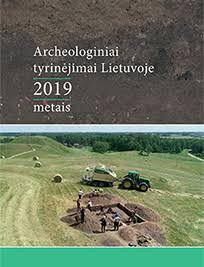
The Investigation of the Site of the Great Synagogue of Vilnius
Vilniaus Didžiosios sinagogos vietos tyrimai
Gintautas Zabiela, Justinas Račas, Jon Seligman and Zenonas Baubonis. 2020. Archeologiniai tyrinėjimai Lietuvoje 2019 metais (Archaeological Investigations in Lithuania in 2019). Vilnius: Lietuvos archeologijos draugija, 2020: 208–211. In Lithuanian with an English summary.
English summary: In 2019, in continuing the investigation of the site of the remains of the foundation of the Great Synagogue of Vilnius, 6 trenches (a total of 167.5 m²) were excavated, revealing a cultural layer up to 2.6 m thick with rubble created during the 20th-century demolition of the synagogue’s buildings and the later levelling of the surface. The N, W and S corners of the former synagogue building were unearthed in the trenches and the location and construction of the wall of the SE vestibule were checked. The locations of the synagogue’s two entrances and the columns were discovered. The bimah floor was unearthed to the S of a kindergarten building located on the plot and a memorial plaque, not shown in the plans and photographs, was discovered. An 18th-century cellar was discovered under the bimah and excavated. The roof, which was determined to be at street level, of the passage between the synagogue and the bathhouse complex was discovered at a depth of 30 cm in the N part of the plot. The entrance to one of several known cellars was found to the N of it and an underground corridor leading to other cellars was perhaps identified. It was determined that the cellar’s brick walls had been built in the 18th century. Another mikveh and the site of a synagogue entrance were also unearthed.
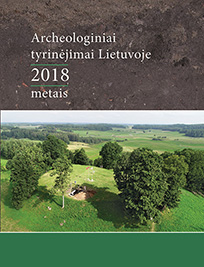
The Investigation of the Remains of the Great Synagogue of Vilnius
Vilniaus Didžiosios sinagogos liekanų tyrimai
Simona Širvydaitė, Jon Seligman, Zenonas Baubonis and Justinas Račas. 2019. Archeologiniai tyrinėjimai Lietuvoje 2018 metais (Archaeological Investigations in Lithuania in 2018). Vilnius: Lietuvos archeologijos draugija, 2019: 272–276. In Lithuanian with an English summary.
English summary: During the 2018 investigation, the N corner of the synagogue building and the remains of the base of the bimah that stood in the centre of the synagogue were discovered. The level of the synagogue’s floor was reached in three locations (in trenches 8, 10 and 11). The investigation of the mikveh, which had been started the previous year, was completed. The NW exterior wall of the bathhouse and the remains of other masonry buildings near it were unearthed. The rubble layers, up to 1 m deep, which contained individual finds and were created in demolishing buildings in the mid-20th century, were excavated in the vast majority of the locations. These layers were thicker only at the locations investigated inside the building, where the hole it left was also filled with rubble; the discovered layers at these locations were up to 2 m deep. The masonry walls discovered during the architectural investigation date to the 18th–19th centuries.
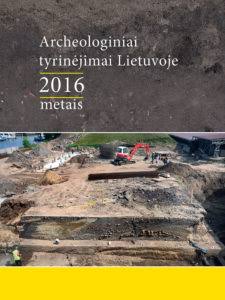
The Grounds of the Great Synagogue Complex in Vilnius
Vilniaus Didžiosios sinagogos komplekso teritorija
Mantas Daubaras, Zenonas Baubonis, Jon Seligman, Harry Jol and Richard Freund. 2017. Archeologiniai tyrinėjimai Lietuvoje 2016 metais (Archaeological Investigations in Lithuania in 2016). Vilnius: Lietuvos archeologijos draugija, 2017: 217–220. In Lithuanian with an English summary.
English summary: An excavation was conducted at the site of the Great Synagogue building complex on the plot at Vokiečių St. 13A in Vilnius Old Town. In 2016, two trenches (51 m²) were excavated at the sites of anomalies recorded during the 2015 geophysical survey of the site of the former Great Synagogue. The investigation sought to determine the site of the pipes supplying water to the synagogue complex, their extent and direction, and to ascertain the location of the miqveh (ritual bath) or the communal well. The investigation results showed that a horizon, up to 3 m thick, of different layers, which consist of a 15th (?)–18th-century layer, rubble and displaced soil predominated at the site. Although building fragments (18th–19th-century) were unearthed in the trench, there is still insufficient data to connect them with the features in question.